
The best German text to speech setup depends on one choice most people skip: the variant. For natural results, pick a neural voice in the German your audience actually speaks — Standard for most uses, Austrian or Swiss for Vienna or Zurich. Free browser tools cover short texts; long narration is what paid tools are for.
German exposes weak text to speech faster than most languages. It glues words into compounds — your health insurance card is a Krankenversicherungskarte — and a voice that puts the stress on the wrong syllable, or reads a long compound as one flat drone, sounds wrong within seconds. It also has two different "ch" sounds (soft in ich, throaty in Bach) that cheap voices blur into one. So this guide judges every tool on two things: whether it offers the variant you need, and whether its German survives a compound word.
Quick Answer: The Best German TTS Tool
For a short text right now, use TextToSpeechH: free, no sign-up, neural Standard German voices, MP3 download in the browser. For the widest choice of German voices in one place, go to Narakeet. Need an Austrian voice specifically? Amazon Polly has one (Hannah). Swiss? Microsoft Azure (Leni and Jan).
Quick picks: German TTS at a glance
| Tool | Best for | German variants | What "free" really means |
|---|---|---|---|
| TextToSpeechH | Free short texts, zero setup | Standard German | Fully free in the browser, no sign-up; built for short-to-medium texts |
| Narakeet | Biggest German voice shelf | Standard German, plus other regional variants | First 20 files free, no registration; then paid by output duration |
| ElevenLabs | Most realistic narration | Standard German (one voice can speak many languages) | Small free allowance to test; serious use runs on paid credits |
| Speechify | Listening to documents and books | Standard German | Subscription app; free use is a taster, not the product |
| Amazon Polly | Developers, apps, Austrian voice | Standard + Austrian (Hannah) | Pay per character through AWS; an API, not a friendly website |
| Microsoft Azure Speech | Swiss German, enterprise work | Standard + Austrian + Swiss (Leni, Jan) | Pay per character; developer platform with a Speech Studio front end |
One honest caveat: "supports German" on a pricing page tells you almost nothing. Two tools can both list German and differ wildly — one has a single Standard German voice, the other has over a hundred, plus Austrian and Swiss options. Read the variant column first.
Best free German text to speech
Free German TTS is genuinely good in 2026 — as long as your text is short and Standard German is what you need.
TextToSpeechH is the pick we can vouch for personally, because it is ours: paste German text into the free tool, choose a German neural voice, and download the MP3 — no account, no card, nothing to install. It is the fastest route for a paragraph, a lesson script, or testing how a voice handles your text before you commit anywhere. The honest limits: it offers Standard German only (no Austrian or Swiss voices), and it is built for short-to-medium passages, not for narrating a whole book.
Narakeet is the other free starting point worth knowing. Its German shelf is unusually deep — 130 Standard German voices by its own count, with more in other regional variants — and you can create your first 20 files free without even registering, downloading MP3 or WAV. It is the better free pick for comparing several German voices side by side, or for document-length text.
What free tiers will not give you: a guaranteed Austrian or Swiss voice, or book-length generation without friction. Free is for learning, testing, and short jobs. The moment the audio goes into a paid course or a client video, read the licence before you publish, not after.
Best realistic German voices
Realism in German is mostly a pronunciation test. Before you pay for any tool, run the same two sentences through it: one with a long compound (Meine Krankenversicherungskarte liegt im Handschuhfach — my health insurance card is in the glove compartment) and one mixing both ch sounds (Eigentlich möchte ich noch ein Stück Kuchen). A good voice keeps the compound's stress on its first part, separates the soft ich sound from the throaty Bach sound, and does not pause in the middle of a word it failed to split.
ElevenLabs is where most people land for flagship realism. German is covered by both its Multilingual v2 model and the newer Eleven v3, and its voices carry emotion better than the cloud platforms — a German audiobook sample or a character line sounds performed, not read. You pay in credits, and costs climb fast on book-length work, but for a video intro, an ad, or a course trailer, it is the quality benchmark here.
Amazon Polly's neural German voices — Vicki and Hans are the long-standing pair — are a different kind of good: less theatrical than ElevenLabs, but steady and consistent across very long texts, which is exactly what e-learning and IVR-style content needs. Because Polly is an AWS service, you get developer controls (SSML, speech marks, per-character billing) instead of a friendly editor — worth it if you are building German audio into an app or generating in bulk.
Narakeet's neural German voices sit between the two: not quite ElevenLabs-level acting, but far more voices to cast from, and a workflow a non-developer can actually finish — upload a script or slides, pick a voice, download. For many creators, that beats a marginally better voice locked behind an API.
German variants: Standard vs Austrian vs Swiss
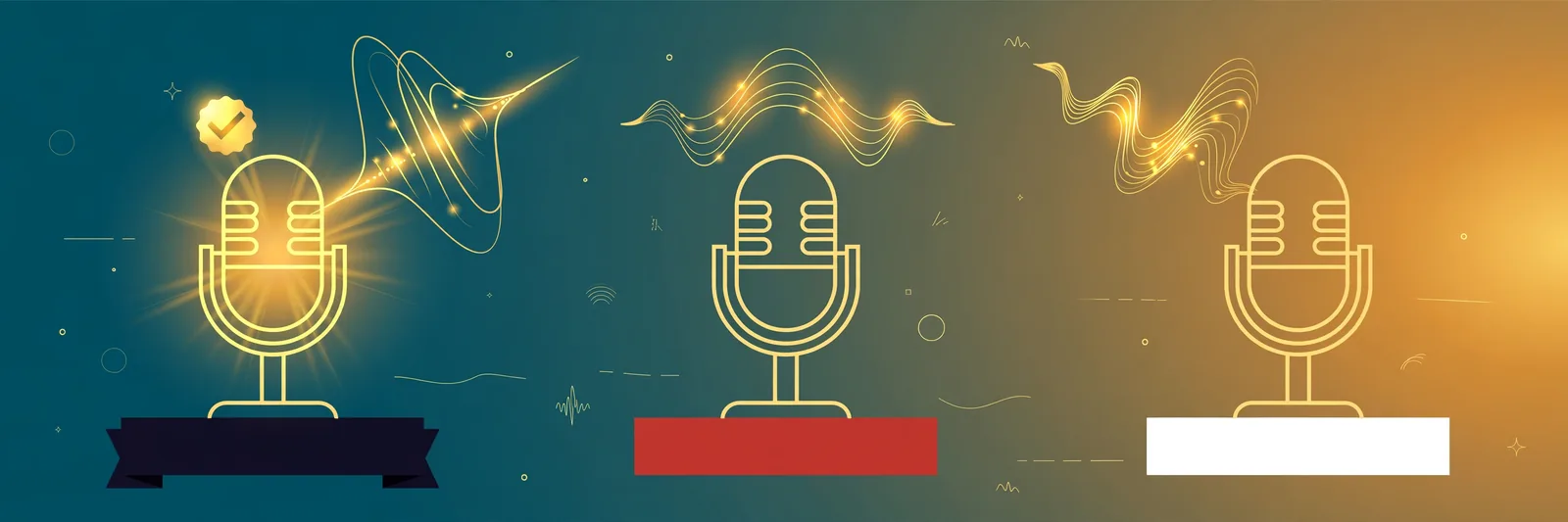
German is one language on paper and three products in practice. Roughly 90–95 million people speak it as a first language, based on the published estimates summarized in Wikipedia's geographical-distribution data, and the Goethe-Institut puts mother-tongue speakers at around 100 million — spread across three countries that do not sound identical, and your listeners will hear the difference.
Standard German (de-DE) is the default everywhere: the German of national news, schoolbooks, and exams. If you are unsure which variant you need, you need this one.
Austrian German (de-AT) is Standard German's close sibling — same written language, different melody, some different everyday vocabulary, and a noticeably softer delivery. An audience in Vienna will not misunderstand a Berlin voice, but Austrian-facing content (local ads, tourism, Austrian e-learning) sounds more at home in an Austrian voice. Dedicated Austrian voices are rare: Amazon Polly's Hannah is the best-known one, and Azure also lists an Austrian locale.
Swiss German (de-CH) needs a clarification first: text to speech tools mean Swiss Standard German — the written standard used in Swiss schools, news, and business — not the spoken Swiss dialects, which are a different world and are not what any mainstream TTS sells. Two practical consequences: Swiss Standard German has its own pronunciation conventions, and Switzerland does not use the ß — Grüße is written Grüsse. Microsoft Azure is the clear Swiss pick, with two dedicated de-CH voices, Leni (female) and Jan (male). If your text contains ß and your audience is Swiss, fix the spelling before you generate.
The rule of thumb: match the voice's country to the audience's country. When in doubt, Standard German is never a wrong answer — just a touch foreign-sounding.
German text to speech for learners
If you are learning German, a TTS voice is the strictest pronunciation teacher you own: it reads exactly what is written, at a steady pace, as many times as you ask, without getting tired or embarrassed for you. Use it three ways. First, shadowing: play a sentence, pause, and repeat it aloud copying the rhythm — German sentence melody is half the battle. Second, compound training: paste a paragraph, listen for where the voice splits long words, and you will start hearing the little words inside the big ones, which is how German vocabulary actually unlocks. Third, dictation in reverse: listen to a generated sentence and write it down, then compare — the gaps show you exactly which sounds you are not hearing yet.
Choose a Standard German neural voice for learning, because that is the German your course and exams are built on; dialect colour is a distraction at A1–B1 level. Slowing playback slightly helps more than any app feature. The same listen-and-shadow method works for other languages, by the way — we laid it out step by step in our guides to the best French text to speech tools and the best Italian text to speech tools, and the routine transfers unchanged.
Speechify deserves a mention here for a different job: it reads your existing documents — PDFs, articles, textbook scans — aloud in German, which makes it the practice tool for listening stamina rather than sentence-level pronunciation. It is a subscription app, and its German is Standard German only.
One warning: do not learn pronunciation from an old robotic voice. Today's free neural voices are good enough to copy; the robotic ones teach stress patterns no German speaker has.
German TTS for creators and e-learning
For creators, the workflow matters more than the single best voice. A YouTube narration needs one great take of a five-minute script — ElevenLabs territory. A 40-module training course needs the same voice, at the same pace, regenerated cheaply every time a slide changes — that is Polly or Azure territory, where per-character pricing and SSML controls beat raw acting quality. Narakeet earns its place when the source material is slides — narrated presentations are its home turf.
Three checks before you commit a project to any of them. Consistency: generate chapter one and chapter ten in the same session settings and compare — some voices drift in energy over long scripts. Terminology: German technical and brand terms are where TTS goes to die; keep a small pronunciation list and test your ten most important words first. Rights: a free tier that lets you download an MP3 does not automatically license it for a monetised video or a paid course — check the plan terms for commercial use, especially on free tiers.
For e-learning, prefer the voice your students can listen to for an hour. The plainer Polly or Narakeet voice your learners stop noticing after two minutes will teach more than a dramatic ElevenLabs read they admire and tune out.
The bottom line: German TTS rewards one decision made early: pick the variant first, the tool second. Standard German covers most learners and most content, and for short texts the free route — TextToSpeechH in the browser, Narakeet for voice shopping — is honestly enough. Go paid when the work gets long or specific: ElevenLabs for the most human read, Polly for Austrian Hannah and developer control, Azure when your audience is Swiss. Whatever you choose, test it on a compound word before you trust it with a script.
By Mauhnish — I build TextToSpeechH and write these guides from what actually works when you test it, not from feature lists. If a step above didn't work the way I described, the tool changed — tell me and I'll fix the guide.
Frequently Asked Questions
What is the best free German text to speech tool?
For short texts, TextToSpeechH: it is free in the browser, needs no sign-up, uses neural German voices, and downloads straight to MP3. Its honest limit is scope — it offers Standard German, not Austrian or Swiss variants. For longer free tests, Narakeet lets you create twenty files before asking you to register.
Which tool has Austrian or Swiss German voices?
Amazon Polly has a dedicated Austrian German voice, Hannah, alongside its standard German voices. For Swiss German, Microsoft Azure is the clear pick: its de-CH voices are Leni (female) and Jan (male). Most consumer apps, including Speechify and our own tool, offer Standard German only, whichever country you are in.
Is German TTS good for learning pronunciation?
Yes — with one condition: use a neural voice, not an old robotic one. A good German voice models the two different ch sounds in ich and Bach, keeps compound-word stress on the first part, and lets you shadow real sentences. Pair listening with the written text, slow the speed slightly, and repeat aloud.
Can I download German TTS as MP3 for free?
Yes. On TextToSpeechH you generate the German audio in your browser and download the MP3 free, with no account. Narakeet also exports MP3 (and WAV) and lets you make twenty files free before registration. On developer platforms like Polly and Azure, MP3 output is standard too, but you pay per character.
Sources & References
- W3C Web Accessibility Initiative — "Audio Content & Video Content" text-to-speech guidance: www.w3.org/WAI/media/av/av-content/
- Wikipedia — Speech Synthesis & Speech Recognition: en.wikipedia.org/wiki/Speech_synthesis
- van den Oord et al. — WaveNet: A Generative Model for Raw Audio: arxiv.org/abs/1609.03499
- Shen et al. — Natural TTS Synthesis by Conditioning WaveNet on Mel Spectrogram Predictions (Tacotron 2): arxiv.org/abs/1712.05884
- Google — Neural Text-to-Speech & AI Overview documentation: cloud.google.com/text-to-speech